
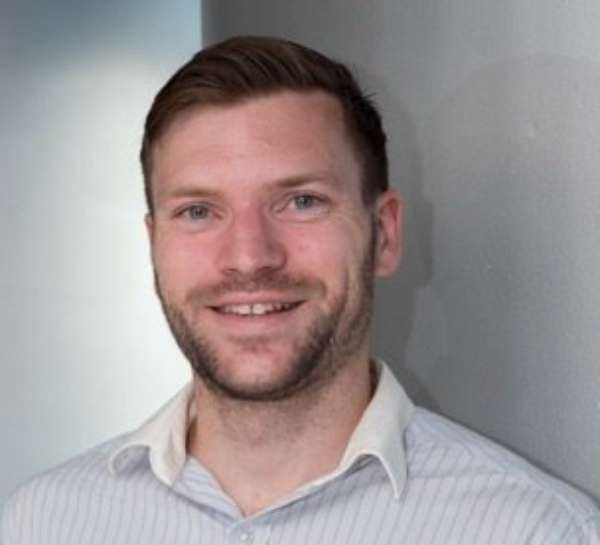
Lewis is a consultant clinical scientist in our Nottingham laboratory. He shares some insights into his role, how the team functions and his career moves to date.
What inspired you to pursue a career in science?
I took my trainee role after a degree in genetics at the University of Nottingham. I always wanted to be a scientist; both my parents were scientists and I found genetics the most interesting area because of the way DNA can create so many different complex living organisms.
How long have you worked at Nottingham?
I started in the Nottingham Laboratory in December 2006, as trainee clinical scientist. At the time it was the Medical Genetics Laboratory for the East Midlands. When the NHS Genomic Medicine Service was set up in 2018 we became one of the labs that is part of East Genomics supporting the whole East region (East Midlands and East of England).
How did you progress to consultant clinical scientist?
I took the Higher Specialist Scientist Training (opens in a new tab) (HSST) programme between 2015 and 2020, which allowed me to learn whilst working as a clinical scientist.
Alongside the HSST program, when in the laboratory, I was able to manage a variety of different disease testing services and contributed to quality management and training in the department. This experience gave me the knowledge and skills required to advance to senior clinical scientist in 2021.
From 2024 in a secondment role as a principal clinical scientist covering the rare disease side of the service, I was able to gain further experience of the managerial and strategical aspects of the genomics service that led to my appointment as a consultant clinical scientist.
Do you focus on specific rare diseases?
As a senior clinical scientist, I oversaw the services for various rare disease conditions including: spinal muscular atrophy (SMA), Prader-Willi and Angelman syndromes, myotonic dystrophy, uniparental disomy, Duchenne muscular dystrophy and haemochromatosis.
This involved deciding the technical processes that should be used, prioritising samples, writing reports for the clinicians, or more often authorising the reports from other members of the team.
The consultant role has less day to day management of the individual disease services, however I still maintain my skills it these areas to be able to authorise reports, understand the testing pathways and provide cover where needed.
Currently I most enjoy the challenge posed by whole genome sequence analysis due to the complex nature and the need to think broadly around the gene, variant and the patient phenotype and bring together a variety of knowledge to turn it into insights that can benefit the patient.
What else does your role entail?
My current role has a lot of management responsibilities including overseeing the rare disease strategy in the lab, ensuring our management structures best fit the demands of the service and leading various transformational projects.
Currently, in Nottingham as a department, we are introducing further cross working and collaboration between the cytogenetics and molecular genetics teams to improve resilience in the service. This includes aligning systems to improve efficiency and make things easier for our teams. Ultimately this means a faster, more reliable service for clinicians and patients.
I am also the training officer for genomics in the Nottingham lab with time dedicated to supporting continuous professional development of our scientist trainees (STPs) and healthcare scientists.
How large is the team in Nottingham?
The three East Genomics labs are very different sizes. In Nottingham we have around 70 people. Approximately half of our team focus on inherited and rare diseases; with the others focusing on acquired cancer. I work with five senior scientists on rare disease. The whole team is extremely dedicated in the work they do; we are a close-knit team that works well together.
What are the benefits of working in a small laboratory?
There is a great variety of work that spans many diseases. We also work across the whole department so there is never a dull day!
We also need to have quite a large input into quality processes, as these are vital to ensure a well-functioning laboratory, and often get involved in generating and checking activity figures.
How has genomic testing changed since you started in your role?
The role and profile of genomics in healthcare has grown enormously and the technology involved has changed dramatically. The number of conditions that are diagnosed and treated with the aid of genetic testing has increased, with sample numbers growing quite rapidly.
The increasing demand for testing means we’re always exploring ways to improve efficiency, while operating a growing number of different test methods. It is certainly an interesting area of science to work in!
Working as part of East Genomics allows us to further scale up to support greater patient numbers. With methods such as large panels and whole genome sequencing (WGS), some samples get sent on to the Cambridge Laboratory for processing but we still do analysis and reporting work here in Nottingham.
We share some multidisciplinary team meetings (MDTs) with the other East Genomics labs to ensure best practice and shared access to expertise across the region.
In summary what do you like most about your role, and what are the challenges?
I really enjoy the training side of my role - working with the STPs coordinating their rotations, assessing their training activities which includes professional practice as well as scientific responsibilities such as reporting and analysing diseases.
In terms of challenges, being a small team, we need to be resilient. We have to cover quite a range of areas including taking responsibility for recruitment and finance; it is interesting though can be challenging at times to balance the competing demand.
How do you relax and switch off from work?
I enjoy cross-fit and spending time with my family. Nottingham itself is great to get around as it isn't too big. I like being close to the Peak District and we have good transport access to other parts of the UK.