
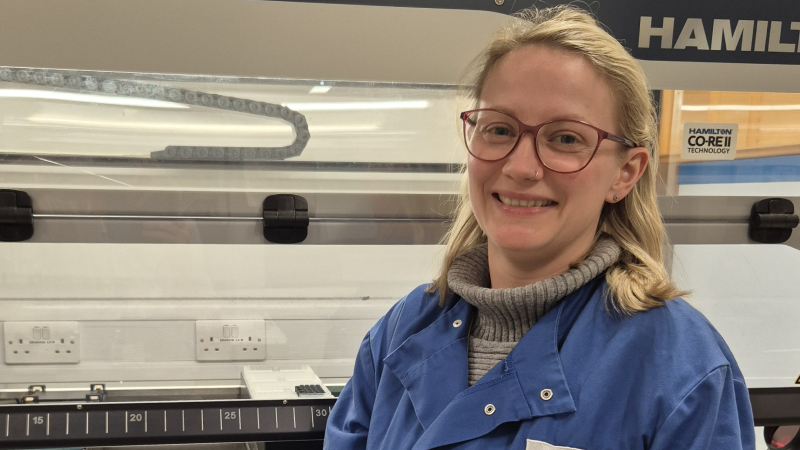
Emma oversees the technical process of extracting genetic material from many kinds of samples sent to our Cambridge lab. It’s a key early step in most genetic testing and an area where we’re making exciting advances in automation to increase our capacity to deliver testing across the region.
What is your role and what does it involve?
I am a technical program manager overseeing the sample preparation and DNA and RNA extraction processes across rare disease, solid cancer and haem-onc. I’m involved in the day-to-day management of the processes as well as improvement projects looking at how we can continue to improve our service in line with our strategic priorities.
I ensure the team is well resourced to deliver both urgent and routine extraction services. When required, I also provide expertise to troubleshoot processes or equipment errors, helping to keep everything running as smoothly as possible.
By working as part of a specialist, multidisciplinary team, I help to ensure that samples progress efficiently through the many different processes our lab provides, so that we can deliver results quickly and efficiently for patients.
How does your role make a difference for patients?
My focus is to provide a high-quality extraction service by looking at the day-to-day running of our processes and looking ahead to the future to see how each process can be improved regarding quality, turn-around-time and capacity.
Making sure we quickly and reliably extract DNA and/or RNA from the samples we receive is a key part of ensuring we produce accurate, meaningful data that can inform diagnosis and treatment for patients.
What excites you about working in science?
I have always loved lab work. I enjoy the practical element of it but also enjoy diligently following a protocol to achieve a desired outcome.
On top of that, it means a lot that my work makes a real difference for people’s lives. Doing my best for patients, has driven me to want to learn more about genomic techniques and to progress my career.
When and how did you decide to specialise in genetics?
I first joined the Cambridge lab as a healthcare science assistant in 2014 before the NHS Genomic Medicine Service was created. We have made a lot of progress since then. When I joined I knew little about genomics but was eager to use my lab skills and have a purpose in helping patients.
It didn’t take long to fall in love with genomics and I enrolled on the Genomic Medicine master’s course in 2015. The knowledge I gained whilst working at the same time helped me to find my passion in optimising processes and leading a highly skilled team.
I became a genetic technologist in 2015 and then became DNA and RNA extraction lead in 2019. I started my current role in 2023.
What skills and qualifications are useful in your role?
Leadership experience is essential. I see this role as very much a support role for both the technical leads and the laboratory staff actually performing the processes.
Having a master’s degree is required but there are many options to gain this while working your way up through the lab, and that hands on experience is also really valuable. The Genomic Medicine master’s is the most relevant but there are others too.
What do you enjoy most about your role?
The people I work with are all dedicated to their work and we are all aligned in wanting to achieve the same goal; to provide accurate results in a timely manner for patients receiving genomic testing.
I enjoy working with a multidisciplinary team where you can collaborate and learn new skills from each other.
What are your hopes for the future?
I’m excited about our ongoing work to implement more efficient, automated extraction processes. These offer opportunities to increase our capabilities and help the team to gain new skills. Ultimately this is going to provide the scale and scope we need to deliver the NHS vision for genomics to become more widely used in the prevention, diagnosis and treatment of diseases.
How else do you like to spend your time?
I have a two-year-old daughter and two cocker spaniels, so I spend a lot of time running around after them!
I love my garden; I have a small veg patch I like to grow what I can – a lot is trial and error still. My husband and I have recently finished renovating our house, but we are always looking for a new project.