
Put simply, genomics is the study of an organism’s genome – its genetic material – and how that information is applied. All living things, from single-celled bacteria to multi-cellular plants, animals and humans, have a genome – and ours is made up of DNA.
Genetics and genomics both play a role in health and disease and while they sound similar there are small differences between the two.

What is genome sequencing?
Sequencing is a technique that is used to ‘read’ DNA. It finds the order of the letters of DNA (A, T, C and G), one by one, and therefore enables us to find the sequence of someone’s unique 3 billion letters of DNA (aka their genome).
By reading the letters of DNA, scientists can then spot and identify changes in a person’s genome. They can use these changes to help them understand why a person may be unwell or predict if they are at a higher risk of disease.
How is genomics used in the NHS?
The development of new genomic tests and techniques has shaped how the testing is used in our NHS.
In the last 20 years or so the field of genetic and genomic testing has advanced rapidly. The development of new tests and techniques has shaped how the testing is used in our NHS.
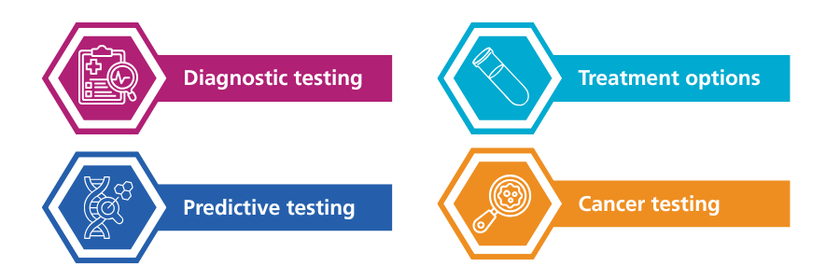
Some examples of how these tests can be used in healthcare are:
- Diagnostic testing
- Predicative testing
- Cancer testing
- Treatment decisions
Genomics throughout life
Genomic testing is now integral to many parts of the NHS at multiple stages of a person’s life:
Preconception
- Testing of parents prior to conception to provide information on inherited conditions.
Pregnancy
- Delivery of fetal genomic testing, including non-invasive prenatal testing, to provide families and clinical teams with as much genomic information as possible.
Newborn / Infancy
- The newborn blood spot screening test provides further genetic information to new parents, while research programmes like the Generation Study hope to diagnose treatable conditions earlier.
Childhood and beyond
- Throughout life genomic testing may be a vital part of a persons healthcare journey. Testing for rare diseases, providing vital information following a cancer diagnosis and, in a developing field, understanding how our genes may impact our reaction to medication.