
Wherever possible, the NHS genomic medicine service aims to provide actionable results from testing.
In line with this goal, the next update to the national genomic test directory update is expected to further simplify available tests for developmental disorders, to give you the best chance of gaining valuable insights into your patient’s genome first time.
The national genomics test directory (NGTD) is typically updated around April each year. To receive email communications from us including about updates to the NGTD, sign up here.
Withdrawn tests (R29, R59, R377)
When the NGTD is updated these tests are expected to be removed from the directory:
- Whole genome sequencing (WGS) for intellectual disability (R29)
- Microarray for intellectual disability (R377)
- WGS for early onset or syndromic epilepsy (R59)
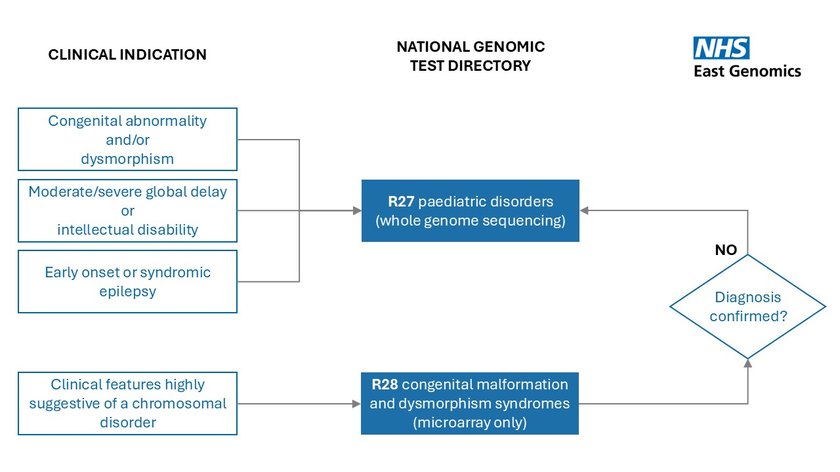
Eligible patients should instead be referred for R27 or R28 (details below). In many cases, this will mean requesting WGS testing in place of microarray.
Non-urgent advice: Important notes on WGS ordering
If you are unfamiliar with ordering WGS tests, please note that the process for ordering WGS tests differs from other test orders and we have specific guidance available.
Most results are received within the commissioned turnaround time, however please be aware that testing can only start once all relevant ordering paperwork has been received, including test order form, consent and familial samples. This may add some delays from the time your patient was seen in clinic.
Support during the transition
In the short term, the lab will automatically reassign existing WGS test orders for R29 and R59 to R27.
Samples sent for test R377 will have DNA extracted and stored. A letter will be sent to the requesting clinician to request further input on what test is desired.
We encourage clinicians to carefully consider eligibility criteria for R28 and R27 where patients were previously eligible for R377 testing, in order to determine if these patients are now eligible for genetic testing.
Guidance on ordering R27 or R28
Aligned with the above, the update will also include changes to the eligibility criteria for both R27 and R28.
- R27 – Patients who meet the eligibility criteria can be offered WGS testing for developmental disorders. – order rare disease WGS
- R28 – Where there is clinical suspicion of a chromosomal cause this microarray test should be requested. In accordance with the eligibility criteria, please include the specific suspected chromosomal disorder on the order form. – order rare disease non-WGS
You may also find our Paediatric Forum recording on this topic valuable (NHS login required).
These changes are intended to reduce the number of requests for retesting and increase the likelihood of achieving a clinical diagnosis for patients from the first test.
Non-urgent advice: Ordering the right test
Please always check the current national genomic test directory before ordering and include full details of your patient’s eligibility in your order. Further guidance on ordering the Right Test, First Time is available.
Holoproscencephaly (R85)
An update to the eligibility criteria will highlight that holoprosencephaly testing (R85) overlaps with R27 and R28 as well as R26. You are encouraged to eliminate chromosomal disorders (possibly via R28) prior to ordering R85.
These changes will be part of a wider update to the national genomic test directory and will build on previous alterations made early last year.
If you have any questions, please contact us.